

DALAI LAMA CENTER FOR PEACE AND EDUCATION
How do we educate the hearts of children?
His Holiness The Dalai Lama called on schools to educate children’s hearts as well as their minds. How do you educate the heart? We explored integrating mindfulness into public school curricula and developed a solution that encourages and enables teachers to share best practices.
Overview
Research and classroom observation showed that mindfulness programs measurably improve children’s well-being, behavior, and learning outcomes. Teachers who used them strongly supported broader adoption—yet these practices remained largely absent from everyday education.
Problem
The solution prioritized teacher-led adoption, low barriers to entry, and peer-to-peer knowledge sharing. Rather than competing for administrative buy-in, the design empowered educators to introduce mindfulness organically through a free, digital toolbox of resources, activities, research, and support. By reducing cost, simplifying access, and leveraging trusted teacher networks, the approach enabled mindfulness practices to spread sustainably within classrooms and across school communities.
Solution
30+
Interviews with DLC members, school admins, teachers, conference attendees, and students
200+
Hours of primary and secondary research
>1,000
Post-its, sketches, and visioning documents
4
Kindergarten sing-alongs
“This was a remarkable gift to the cause of advancing the social and emotional learning of children and youth in British Columbia. For all of us engaged with its people and process, never before have we either experienced or even imagined the immediate effects such a group could have on our resolve and capacities for fulfilling our purpose and vision.”
- Chris Kelly, Program Development, Dalai Lama Center
Toolbox
The focus of the entire project, the "Heart-Shaped Toolbox," which is a digital platform to...
Deliver information to help people better understand the benefits of mindfulness.
Centralize resources to help people easily infuse mindfulness into their lives and classrooms.
Facilitate sharing to help people find and use ideas and activities that encourage mindfulness.
Jumpstart conversations to help people introduce mindfulness within their community.
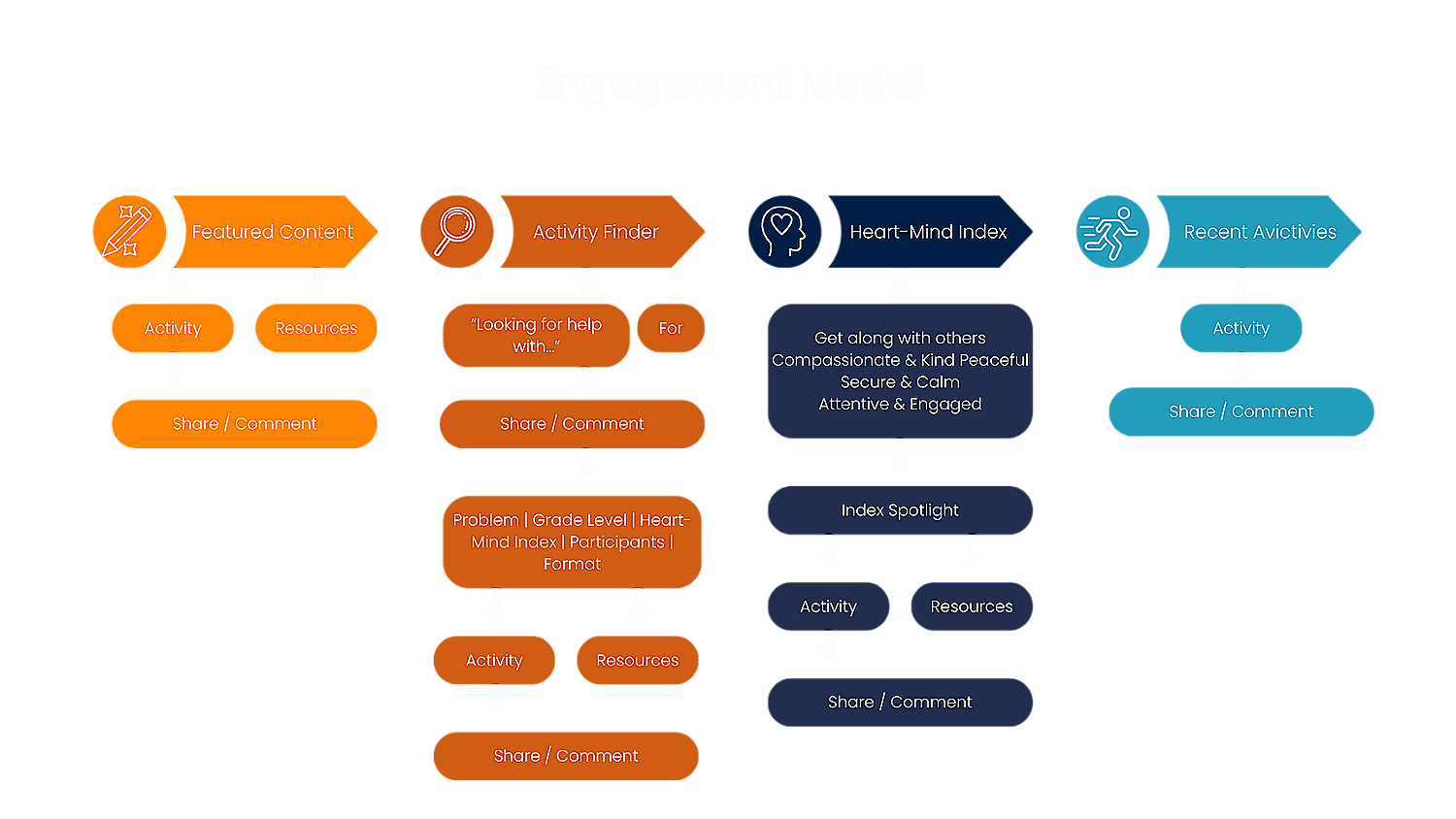
Foster engagement to move people from awareness, to implementation, to advocacy, and to evangelism.
In 2013, a social good hackathon was held with the Webvisions conference in Portland to produce prototypes for the project.
The Future
This was the first time I was able to participate, ask questions, and contribute to the project.
I was taught how wireframing and visioning was, as well as how to apply it to my work and school.
I followed alongside interviewers in order to study how they asked questions in an open, but guided way.
There was a room full of people who wanted to change the world with empathy. It shifted my perspective on idealism and how it isn’t naïve, but vulnerable. It inspired me to continue with my work in restorative justice and human rights activism.